

zł49.50 kilogram

Secure payments

Delivery

Return policy
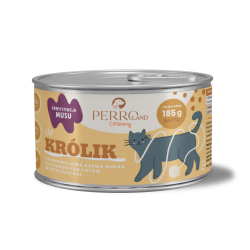
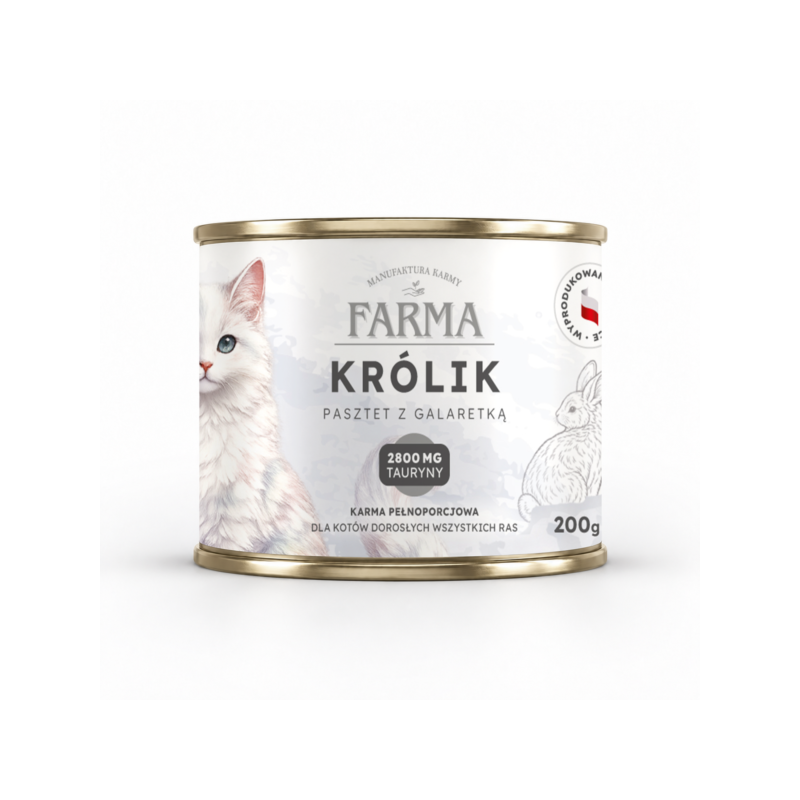
Farma · wet cat food with rabbit · complete · 200 g
Farma Rabbit 🐇
A classic for elimination diets
When it comes to allergies, every ingredient on the label matters. That is why our rabbit recipe is reduced to the minimum: 98.8% meat, vitamins, minerals, and inulin. Nothing else is added.
• 1 animal species
• no chicken
• grain-free
• BPA-free can
• pâté with jelly
98.8% ingredients from one animal
2800 mg/kg taurine
0.11% phosphorus in wet matter
81 kcal per 100 g
What makes Farma stand out
🥩 98.8% meat – one species, therefore zero fillers.
🫀 Heart, stomachs and liver – offal listed down to the percentage, so there are no rounded figures.
💗 Taurine 2800 mg/kg – higher than the typical 2000–2500 mg/kg found on the premium shelf.
⚖️ Phosphorus 0.11% – the lowest in the whole line.
🚫 No chicken or grains – and also no sugar or vegetable oil.
🐟 No fish oil – no krill or mussel, which can be crucial in allergy management.
🥫 BPA-free can – the inside of the can is free from bisphenol A.
🇵🇱 Polish manufacturing – we know every batch because it is made by us.
Rabbit has long been a first-choice protein for elimination diets. Its meat is lean, easy to digest, and has a low allergenic potential. As a result, a cat's immune system usually does not react to it.
Inside the can you will find muscle meat, rabbit broth, and stomachs, hearts, and liver. We do not add fish oil or shellfish, although many "mono" foods do exactly that.
This variant also has the lowest phosphorus in the whole line, at 0.11% in wet matter. With a full set of offal, that is not easy to achieve.
For whom
Cats with food allergies and intolerances. It is also a choice for owners who read the ingredient list to the very last line.
Why choose Farma with rabbit?
🐇 Protein with low allergenic potential – rabbit is a proven meat for intolerances. However, an elimination diet should be carried out with a veterinarian.
🔬 Truly clean mono – one animal and that is it, meaning no fish oil, no shellfish, and no hidden poultry.
⚖️ Lowest phosphorus in the line – 0.11% in wet matter, with a Ca:P ratio of 1.27:1.
🌿 Zinc and inulin – zinc supports skin and coat. Inulin supports digestion.
🥫 Pâté with jelly – a delicate texture without chunks, making it easy to mix with medication or supplements.
🇵🇱 Polish manufacturing – we know the source of the raw material because we produce in Poland.
What exactly is in the can
59.8% muscle meat
23.0% broth
7.0% stomachs
5.0% hearts
4.0% liver
1.0% vitamins and minerals
0.2% inulin
The meat percentage alone says little, because it also includes broth. That is why we show every component separately.
Full composition and nutritional value
Composition
Rabbit 98.8% (muscle meat 59.8%, rabbit broth 23%, stomachs 7%, hearts 5%, liver 4%), vitamins and minerals 1%, inulin 0.20%.
No grains, fillers, sugar, or vegetable oil. There is also no chicken in the composition. The can has a BPA-free coating.
Analytical constituents
Crude protein – 9.30%
Crude fat – 4.00%
Crude ash – 1.50%
Crude fiber – 0.30%
Carbohydrates – 2.90%
Calcium – 0.14%
Phosphorus – 0.11%
Ca:P ratio – 1.27:1
Moisture – 82.00%
Metabolizable energy – 81 kcal/100 g
"DM" means dry matter, i.e. values after removing water. This column lets you compare wet foods with one another, and also with dry foods. Values are indicative.
Dietary additives / 1 kg
Taurine — 2800 mg
Zinc (3B605) — 15 mg
Vitamin E (3A700) — 40 mg
Vitamin D3 (3A671) — 200 IU
Manganese (3B503) — 3 mg
Iodine (3B201) — 0.75 mg
Rabbit wet cat food compared with the premium shelf
Taurine – Farma Rabbit: 2800 mg/kg; usually on shelf: 2000–2500 mg/kg.
Phosphorus in wet matter – Farma Rabbit: 0.11%; usually on shelf: 0.14–0.26%.
Offal – Farma Rabbit: stomachs 7%, hearts 5%, liver 4% – with declared share; usually on shelf: two types or none, usually without percentages.
Fish addition in meat food – Farma Rabbit: none; usually on shelf: salmon oil or mussel in some "mono" foods.
Chicken in broth – Farma Rabbit: not present; usually on shelf: poultry broth can appear in non-poultry foods.
Can coating – Farma Rabbit: BPA-free, stated clearly; usually on shelf: usually no information.
Can size – Farma Rabbit: 200 g; usually on shelf: most often 185 g.
Country of manufacture – Farma Rabbit: Poland, stated clearly; usually on shelf: often undisclosed.
The right column shows ranges from labels of single-protein wet foods available in Poland, checked in September 2026. We do not name specific brands, because anyone can verify these numbers independently.
What you will not find in the composition
✕ Chicken – it is nowhere in the recipe: neither in the meat, nor in the broth, nor in the additives. In an elimination diet, that is a basic requirement anyway.
✕ Fish oil – a "mono" food with salmon oil stops being a single-protein test, so it is not here.
✕ Crustaceans and mollusks – krill, shrimp, and mussel can be hidden sources of reactions, so they are left out of the recipe.
✕ Grains and fillers – no wheat, rice, peas, or flours, i.e. no ingredients that would later need to be excluded in elimination.
✕ Sugar and vegetable oil – nothing that adds calories without value.
✕ Bisphenol A – the can coating is BPA-free. In a diet where every detail matters, the package matters too.
Good to know
Why so much taurine: cats do not make enough of it, and during meat processing some is lost with the juices. That is why wet foods add more than dry foods. 2800 mg/kg is above what you usually find on the premium shelf.
Heart in the recipe makes perfect sense: it is one of the richest natural sources of taurine. Most foods stop at liver. We add heart and stomachs, so taurine does not come only from an additive.
Phosphorus 0.11% – the lowest in the line: excess phosphorus burdens the kidneys, especially in older cats. Offal usually raises it, so such a low result with a full offal set is not obvious.
Hydration cats do not think about: a cat's thirst drive is weak, as it is a legacy from ancestors in dry regions. Wet food contains about 82% water, so the cat gets it while eating.
BPA: obligation versus choice: the EU is phasing out bisphenol A from cans for human food. That does not apply to pet food. We chose a BPA-free coating ourselves, because a cat may eat from a can every day for years.
How to read the meat declaration: the front percentage also includes broth. Without the breakdown, you do not know how much of each ingredient there is. Ours: 59.8% muscle meat, 23% broth, and 16% offal.
Daily feeding
2 kg – 195 g
3 kg – 255 g
4 kg – 310 g
5 kg – 365 g
6 kg – 415 g
7 kg – 460 g
8 kg – 510 g
The amounts given are indicative. Adjust them to the cat's age, activity, and condition.
Practical tips
Food transition – if there is an allergy, extend the switch to two weeks, as reactions can be delayed. Observe the skin and stool.
Temperature – serve at room temperature so the aroma works in your favor.
Portions – divide the daily amount into two or three servings.
Water – provide constant access to fresh water, even though the food contains plenty of it.
Storage – keep unopened cans at up to 25 °C, away from sunlight. After opening, transfer the remainder to a lidded container and place it in the refrigerator — use within 48 hours. The recipe contains no preservatives, so the shelf life is intentionally short.
Which flavor for your cat
Cats rarely eat one protein for their entire life, so rotation reduces the risk of intolerance. It also makes it easier to tell what really suits the cat. Below is the full line with the numbers that usually decide the choice – for example, for an overweight cat or one over ten years old.
🦆 Duck – protein 9.50%, fat 3.20%, phosphorus 0.12%, 79 kcal, picky cats
🐑 Lamb – protein 9.20%, fat 5.80%, phosphorus 0.12%, 86.5 kcal, sensitive digestion
🐄 Veal – protein 9.80%, fat 5.80%, phosphorus 0.12%, 87 kcal, sensitive stomach
🐇 Rabbit – this product: protein 9.30%, fat 4.00%, phosphorus 0.11%, 81 kcal, allergies, elimination
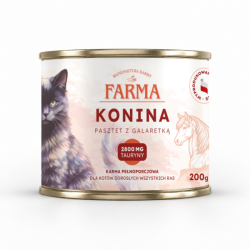
🐴 Horse – protein 9.50%, fat 3.80%, phosphorus 0.11%, 84.2 kcal, rare protein
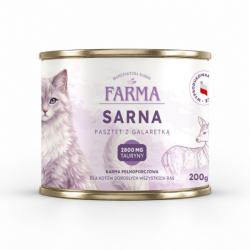
🦌 Roe deer – protein 10.90%, fat 5.20%, phosphorus 0.12%, 89 kcal, connoisseurs, rotation
🐦 Guinea fowl – protein 9.00%, fat 5.00%, phosphorus 0.11%, 79 kcal, poultry without chicken
🐟 Salmon – protein 8.60%, fat 6.40%, phosphorus 0.12%, 89 kcal, skin and coat
The values refer to wet matter and come from product labels. All flavors have the same taurine level and the same set of dietary additives. They differ, however, in protein, fat, and calorie content.

Specific References